
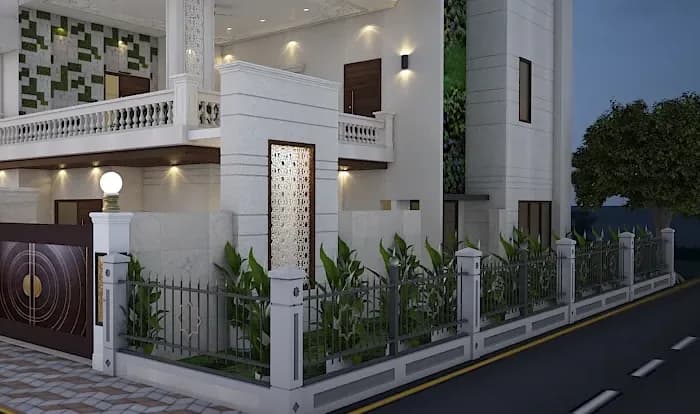
A 6–7 ft brick boundary wall costs about ₹1,550–2,100 per running foot in Delhi NCR in 2026, including the foundation, plaster and paint, while an RCC wall runs ₹2,400–3,400 and a precast one ₹1,850–2,500 (Construction Estimator India, 2026). For the front of a 100 gaj plot, that's roughly ₹39,000–53,000 in brick. This guide covers the cost by wall type, worked examples by plot and the details that decide whether a wall cracks within five years.
Key Takeaways
- Boundary walls are priced per running foot of length at a set height, not per sq ft of plot.
- In Delhi NCR, a 6–7 ft brick wall runs ₹1,550–2,100 per running foot, RCC ₹2,400–3,400 and precast ₹1,850–2,500, before GST (Construction Estimator India, 2026).
- A 9-inch brick wall costs ₹1,200–1,500 per running foot nationally against ₹800–1,100 for a 4.5-inch one (HouseYog, Mar 2026). The thin wall is rarely worth the saving at full height.
- On most NCR plots you build only the front, and sometimes the rear, because the side walls are shared with neighbours.
The boundary wall is one of the costs that sit outside a per-sq-ft construction rate. For how it fits the rest of your budget, see our house construction cost guide for Delhi NCR.
How Much Does a Boundary Wall Cost per Running Foot?
Published 2026 estimates for Delhi NCR put a 6–7 ft, 9-inch brick wall at ₹1,550–2,100 per running foot, including foundation, plaster and paint, with GST extra (Construction Estimator India, 2026). RCC walls cost the most at ₹2,400–3,400, and precast panels sit in between. Nationally, chain-link fencing is the cheapest option at ₹650–950 per running foot.
A second 2026 guide gives lower national figures: ₹800–1,100 per running foot for a 4.5-inch brick wall, ₹1,200–1,500 for a 9-inch wall and ₹1,500–3,000 for RCC, at a standard 5–6 ft height (HouseYog, Mar 2026). The gap comes from height, the depth of the foundation and whether plaster and paint are included, so compare quotes on the same specification.
What Does a Boundary Wall Cost for a 100, 200 or 300 Gaj Plot?
On a typical NCR plot, side walls are often shared with neighbours, so you pay mainly for the front and the rear. A 100 gaj plot with a 25 ft front needs about 25 running feet at the front: roughly ₹39,000–53,000 in 9-inch brick at Delhi NCR rates (Construction Estimator India, 2026). Corner plots and standalone villa plots need far more.
| Plot and layout | Wall length | Brick | Precast | RCC |
|---|---|---|---|---|
| 100 gaj (25 × 36 ft), front only | 25 ft | ₹0.39–0.53 lakh | ₹0.46–0.63 lakh | ₹0.60–0.85 lakh |
| 100 gaj corner plot, front + side | 61 ft | ₹0.95–1.28 lakh | ₹1.13–1.53 lakh | ₹1.46–2.07 lakh |
| 200 gaj (30 × 60 ft), front + rear | 60 ft | ₹0.93–1.26 lakh | ₹1.11–1.50 lakh | ₹1.44–2.04 lakh |
| 300 gaj (45 × 60 ft), all four sides | 210 ft | ₹3.26–4.41 lakh | ₹3.89–5.25 lakh | ₹5.04–7.14 lakh |
The gate is a separate line. An MS or wrought-iron gate is priced by weight and design, and a sliding or motorised gate adds track and motor costs, so get it quoted with the wall rather than after.
Brick, Precast or RCC: Which Boundary Wall Should You Choose?
For most NCR homes, a 9-inch brick wall on a proper footing and plinth beam is the best value: it costs ₹1,550–2,100 per running foot in Delhi NCR, takes plaster and paint like the house, and can be cut later for a new gate (Construction Estimator India, 2026). Here's how the options compare:
- 9-inch brick. The default for a front wall that matches the house. At full height it needs a plinth beam and piers at regular intervals, which your engineer sets.
- 4.5-inch brick. Cheaper, but too thin to stand 6–7 ft on its own. Use it only for low walls or between piers.
- Precast panels. Fast to install and good for long rear or side runs on farmhouse and villa plots, but harder to match to the house finish.
- RCC. The strongest and the most expensive. Worth it where the wall retains soil, such as a plot lower than the road.
- Chain link or grille on a low wall. Cheapest per foot and lets light and air through; common on front walls above a 3 ft plinth.
A common reason boundary walls crack is the base, not the top. A long brick wall built straight on loose filled soil, with no plinth beam and no expansion gap, will crack where the soil settles unevenly. Ask any quote to show the footing depth, the plinth beam and where the piers go. Those three lines matter more than the brick brand.
How High Can a Boundary Wall Be?
Local rules cap boundary wall heights and can require the upper part of a front wall to be open grillwork rather than solid masonry. In Delhi, check the building bye-laws with MCD; in Faridabad and Gurugram, the zoning plan for your sector or colony sets the limits. Confirm the permitted height before the wall is designed, because rebuilding a wall to cut its height costs more than building it right.
Height also drives cost. The rates above assume a 6–7 ft wall; a 5 ft wall on the same footing costs noticeably less per running foot, while anything taller needs a heavier foundation and more piers.
Building a house and its boundary together?
We price the wall, gate and house in one scope, so the footing, plinth and finishes match.
Talk to our teamWhere to Go Next
If you're still working out what to build on your plot, the 100 gaj house construction cost guide shows the floor limits from 50 to 500 gaj. For bigger plots where the wall is a large line, see the villa construction cost guide. The roof is the other part of the envelope that needs care; our terrace waterproofing cost guide prices it by method. When you want one quote for the house and its boundary, see our construction services.