
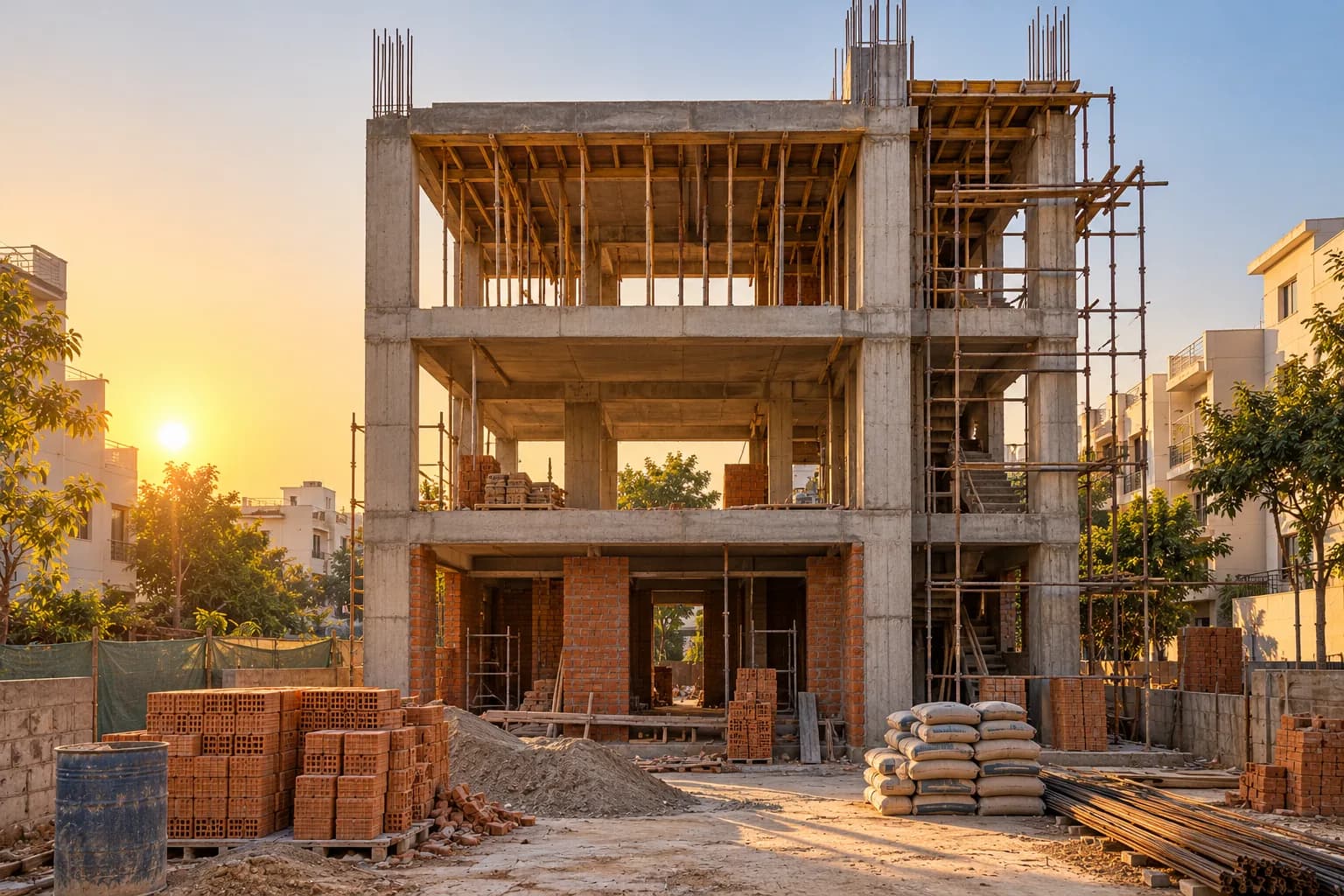
Standard-quality house construction in Delhi NCR costs ₹2,200–3,000 per sq ft in 2026, with economy builds from ₹1,600 and premium ones up to ₹4,500 (JK Cement, Dec 2025). Costs overall are projected to rise another 3–5% this year (JLL via Construction World, Mar 2026). This guide shows what that means per sq ft, per gaj of plot and per floor, and how Delhi, Gurugram, Noida and Faridabad differ before you ask anyone for a quote.
Key Takeaways
- Published 2026 rates for Delhi NCR run ₹1,600–4,500 per sq ft by quality (JK Cement, Dec 2025). Our typical pricing is ₹1,350–2,700 per sq ft for the structure and ₹2,850–5,200 with finishes, before GST.
- A 100 gaj (900 sq ft) Delhi plot allows up to about 3,150 sq ft of covered area under the Delhi master plan, roughly four floors. At standard rates, building all of it costs about ₹69–95 lakh.
- Upper floors cost less per sq ft than the ground floor, because the foundation is already paid for.
- Across NCR, land is what separates the cities, not the build. Average NCR home prices reached ₹9,980 per sq ft in Q3 2026, up 12% in a year (ANAROCK via Business Today, Oct 2026).
How Much Does It Cost to Build a House in Delhi NCR per Sq Ft?
In 2026, Delhi NCR construction runs ₹1,600–2,300 per sq ft at an economy level, ₹2,200–3,000 at standard quality and ₹3,000–4,500 at premium (JK Cement, Dec 2025). Package builders publish similar numbers: Brick & Bolt lists Delhi packages from ₹2,040 to ₹2,900 per sq ft including GST, with luxury homes from ₹4,250 (Brick & Bolt, 2026).
| Source | Area | Range (per sq ft) | Notes |
|---|---|---|---|
| JK Cement | Delhi NCR | ₹1,600–2,300 | Economy quality |
| JK Cement | Delhi NCR | ₹2,200–3,000 | Standard quality |
| JK Cement | Delhi NCR | ₹3,000–4,500 | Premium quality |
| Brick & Bolt | Delhi | ₹2,040–2,900 | Basic to Royale packages, incl. GST |
| Brick & Bolt | Faridabad | ₹1,890–2,750 | Basic to Royale packages |
| Incense Buildtech typical pricing | NCR | ₹1,350–2,700 | Structure only, before GST; falls as covered area grows |
| Incense Buildtech typical pricing | NCR | ₹2,850–5,200 | Structure plus basic to luxury finishes, before GST |
Why do the ranges overlap so much? Each source defines "construction" differently. Some quote the structure alone, others include tiles, paint, sanitaryware and a basic kitchen, and some fold in GST. Before comparing two numbers, ask what each one includes. Our 1000 to 2000 sq ft house construction cost guide shows how the same home lands at very different totals depending on that scope.
Our typical rate falls as the total covered area grows: a large three- or four-floor house costs less per sq ft than a compact single-storey one. Site setup, the foundation, the staircase and supervision are fixed costs, so they weigh more on a small build. That's why per-sq-ft comparisons only make sense between projects of a similar size.
How Much Can You Build on Your Plot, Per Gaj?
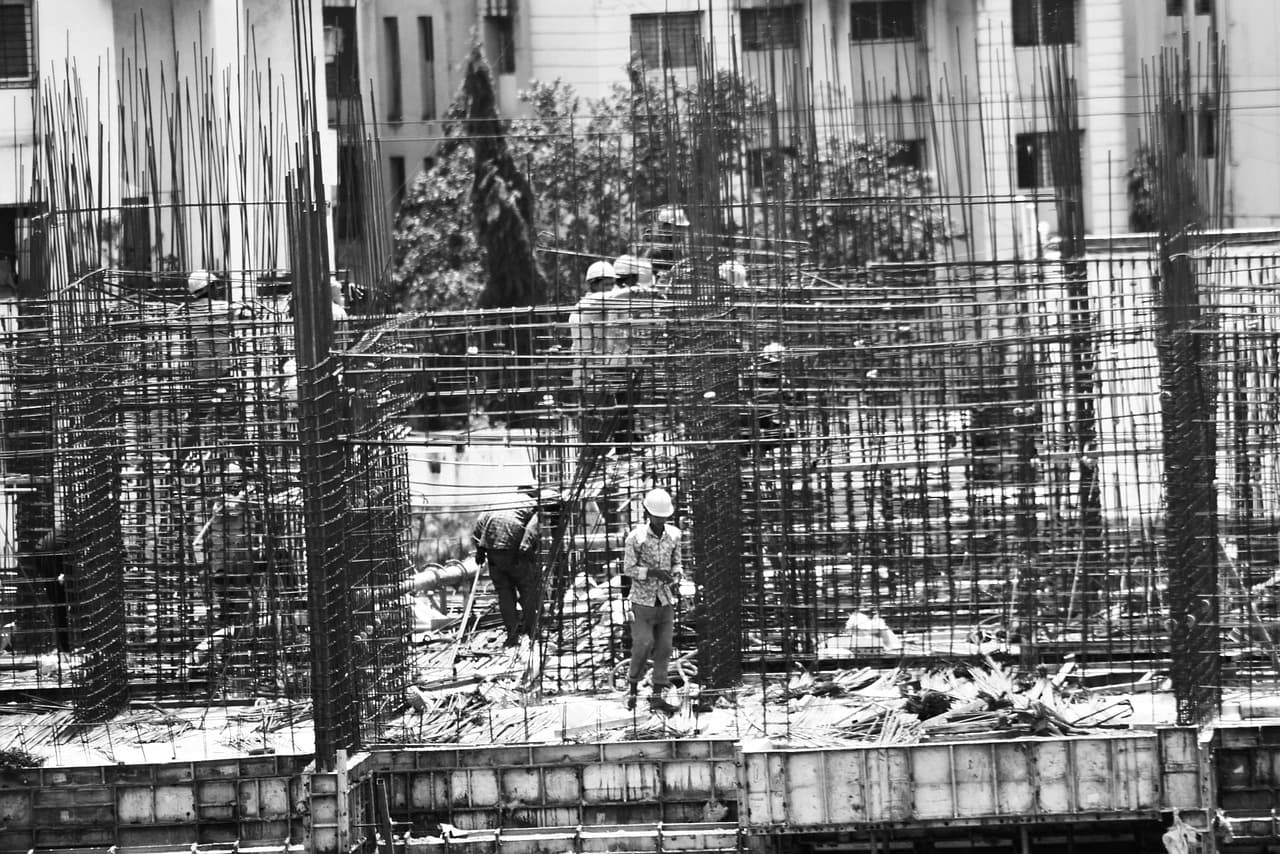
Plots in NCR are sold in gaj, and 1 gaj is one square yard, or 9 sq ft (Wikipedia). In Delhi, a plot of 50–100 sq m (about 60–120 gaj) may cover 90% of the ground and build up to a floor area ratio of 350, under the Delhi master plan as summarised by South Delhi Floors (2026). That's why the plot size, not the house plan, sets your ceiling.
| Plot | Plot area | Max covered area | Cost to build it all |
|---|---|---|---|
| 50 gaj | 450 sq ft | about 1,575 sq ft | ₹34.6–47.2 lakh |
| 100 gaj | 900 sq ft | about 3,150 sq ft | ₹69.3–94.5 lakh |
| 150 gaj | 1,350 sq ft | about 4,050 sq ft | ₹89.1 lakh–1.22 crore |
| 200 gaj | 1,800 sq ft | about 5,400 sq ft | ₹1.19–1.62 crore |
Haryana works differently. Its building code, as amended in 2022, allows 75% ground coverage on plots up to 250 sq m and a base floor area ratio of 165% on plots up to 100 sq m, with more available for a fee (The Tribune, 2022). So the same 100 gaj plot gives a smaller footprint per floor in Faridabad or Gurugram than in Delhi. The full table, from 50 to 500 gaj, is in our 100 gaj house construction cost guide.
How Much Does Each Floor Cost?
Published floor-wise estimates put the ground floor at ₹1,800–2,200 per sq ft and the first floor at ₹1,500–1,800, all-India, because excavation and the foundation sit under the ground floor (Construction Estimator India, 2026). The second floor and above drop slightly again. NCR rates run higher, but the pattern holds here too.
That pattern is why building up is usually the cheapest way to add space, as long as the structure was designed for it. Before you price an extra floor on an existing house, read the first floor construction cost guide: it covers the structural check, the one-off costs of building over an occupied home and the approval picture. If you're weighing a basement instead, the basement construction cost guide explains why going down costs more per sq ft than going up.
Can You Still Build Four Floors in Haryana?
Not on a new approval right now. Haryana's 2024 stilt-plus-four-floor (S+4) policy was stayed by the Punjab and Haryana High Court in April 2026, and on 21 July 2026 the state planning department put all further S+4 approvals on hold (The Tribune, Jul 2026). If you're planning a Faridabad or Gurugram house, budget for the floors your plot was already approved for.
What's Pushing Construction Costs Up in 2026?
Construction costs are projected to rise 3–5% in 2026, led by wages, which are expected to climb 5–12% after India's new labour codes took effect in November 2025 (JLL via Construction World, Mar 2026). Steel, aluminium and copper are projected up a more modest 2–4%. Cement is the material to watch in the north.
North India's average cement price was about ₹365 a bag in late 2025, against ₹335 in the west and ₹325 in the south, and analysts expected prices to rebound from January 2026 (Systematix Research via The Tribune, Nov 2025). Cement, bricks and steel together make up 40–50% of a typical house budget (JK Cement, Dec 2025), so a few rupees a bag adds up across a build.
Put those projections against a typical 1,500 sq ft NCR house and the risk sits mostly in labour. Labour is 15–30% of a house budget depending on how it's counted (JK Cement, Dec 2025), and it's the line projected to move most this year. A quote that fixes material rates but leaves labour open is the one most likely to grow before handover.
Is It Cheaper to Build in Faridabad, Gurugram or Noida Than Delhi?
The build itself costs much the same across NCR; land is what differs. Average home prices across Delhi NCR reached ₹9,980 per sq ft in Q3 2026, up from ₹8,900 a year earlier (ANAROCK via Business Today, Oct 2026). How far that average varies city by city is covered in our Faridabad vs Delhi NCR cost comparison.
What does change between cities is the rulebook. Delhi plots follow MCD and the Delhi master plan; since the 2016 bye-laws, residential plots up to 105 sq m no longer need a sanctioned building plan, only an undertaking and fees (Business Today, 2016). Faridabad and Gurugram plots follow the Haryana building code and HSVP or the municipal corporation. Those rules set how many floors you can build, which matters more to the total than a ₹100 difference in the per-sq-ft rate.
If you're building in Faridabad specifically, our house construction cost guide for Faridabad covers local approvals and worked examples.
Why Does Seismic Design Matter in NCR?
Delhi sits in seismic Zone IV, which the Delhi Disaster Management Authority describes as fairly high seismicity, with occasional earthquakes of magnitude 7–8 possible (DDMA, 2026). In practice, that means RCC frames here are designed with ductile detailing to IS 13920, which adds steel at beam-column joints.
A revised national seismic code with a new zone map was released in November 2025, then withdrawn by BIS in March 2026, so the 2016 standard still applies (ETV Bharat, Mar 2026). Seismic detailing isn't optional on an NCR house, and a quote with an unusually low steel figure is worth questioning.
Which Kind of House Are You Pricing?
The same per-sq-ft logic applies to every kind of house, but the extras differ. A two-level family home needs a staircase and often a double-height space; a villa adds landscaping, a larger footprint and usually a lift; and every independent house needs a boundary wall and a waterproofed roof. Each has its own guide:
- Duplex homes: see the duplex house construction cost guide.
- Villas: see the villa construction cost guide.
- Boundary walls and gates: see the boundary wall construction cost guide.
- Roof and terrace: see the terrace waterproofing cost guide.
What Isn't Included in a Per-Sq-Ft Rate?
Hidden and extra costs can add 15–25% to a construction budget, and JK Cement advises keeping a contingency of at least 10–15% (JK Cement, Dec 2025). The usual items outside a per-sq-ft rate are:
- Design fees, typically ₹100–225 per sq ft of covered area for architecture, structure and interiors, depending on project size.
- GST at 18% on the construction contract.
- Approvals and utility connections, including the completion or occupation certificate.
- Boundary wall, gate and landscaping.
- Lift, front elevation cladding and solar.
- Loose furniture and appliances.
Want a number for your own house?
Enter your covered area and finish level in the Budget Calculator for a typical-pricing range, design fee included.
Try the Budget CalculatorWhere to Go Next
Start with the guide that matches your plan. If you own a plot, the 100 gaj house construction cost guide shows what you can build on it. If you know your home's size, the 1000 to 2000 sq ft cost guide prices it. If you're building on an existing house, read the first floor construction cost guide. Our turnkey vs separate contractors comparison and the step-by-step construction process cover how to run the build. When you want a fixed quote against your own plot and drawings, see our design and construction services.